How to Communicate Haircut Style to Your Barber

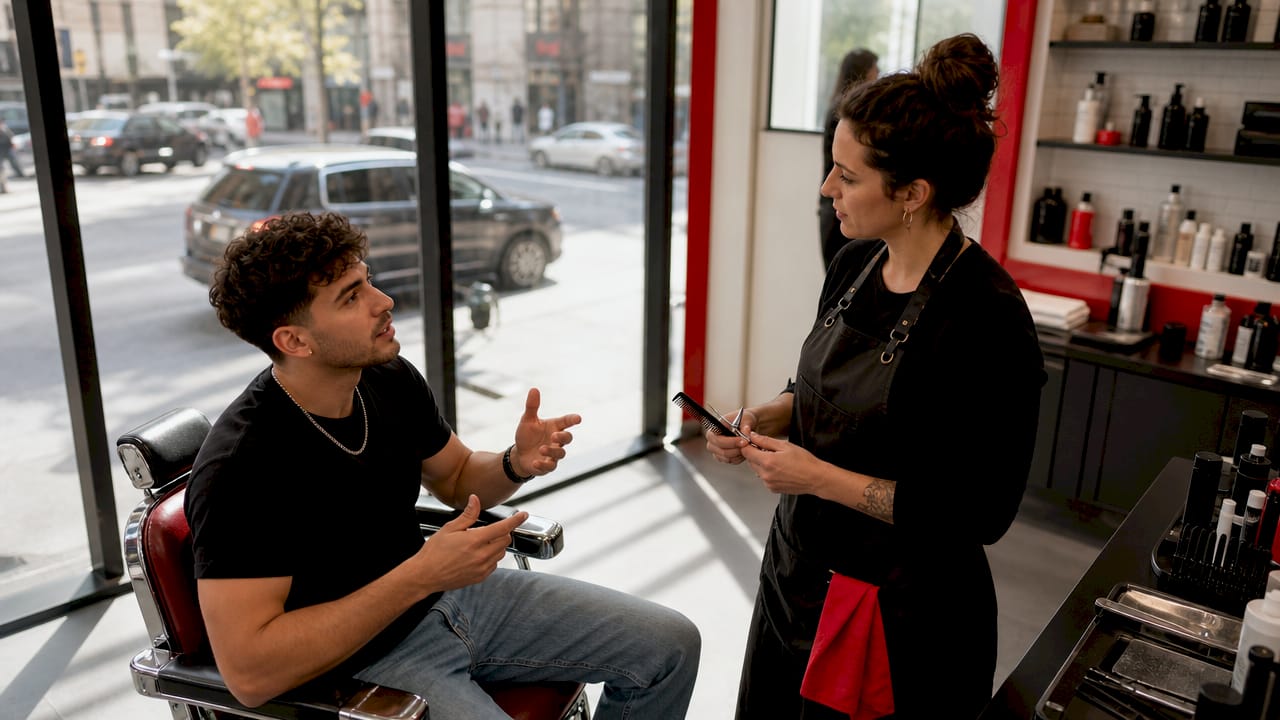
Communicating your haircut style to a barber is defined by three factors: clarity, specificity, and preparation. Walk in without a plan and you risk leaving with a cut that misses the mark entirely. The good news is that barbers at shops like Manhattanbarbershopny are trained to guide the conversation, but only when you give them something to work with. Knowing how to describe haircut preferences, use photos strategically, and speak up during the cut separates clients who leave confident from those who leave disappointed. This guide covers every step of that process.
What basic haircut terminology do you need to know?
The fastest way to communicate haircut style to a barber is to learn a handful of terms before you sit down. Specific terms like fade height, top length, and texture replace vague requests that lead to confusion. A “fade” means the hair gradually shortens from top to sides and back. A “taper” is a subtler version that keeps more length. A “blend” smooths the transition between two lengths without a hard line.
Clipper guard numbers are the most precise tool you have. Guard sizes are measured in eighths of an inch, so a No. 1 guard leaves about 1/8 inch of hair, a No. 2 leaves 1/4 inch, and a No. 4 leaves 1/2 inch. Describing length with guard numbers backed by inch measurements prevents misunderstandings, because guard sizes can vary between barber brands. Saying “a No. 2 on the sides, which is about a quarter inch” is far clearer than saying “short on the sides.”
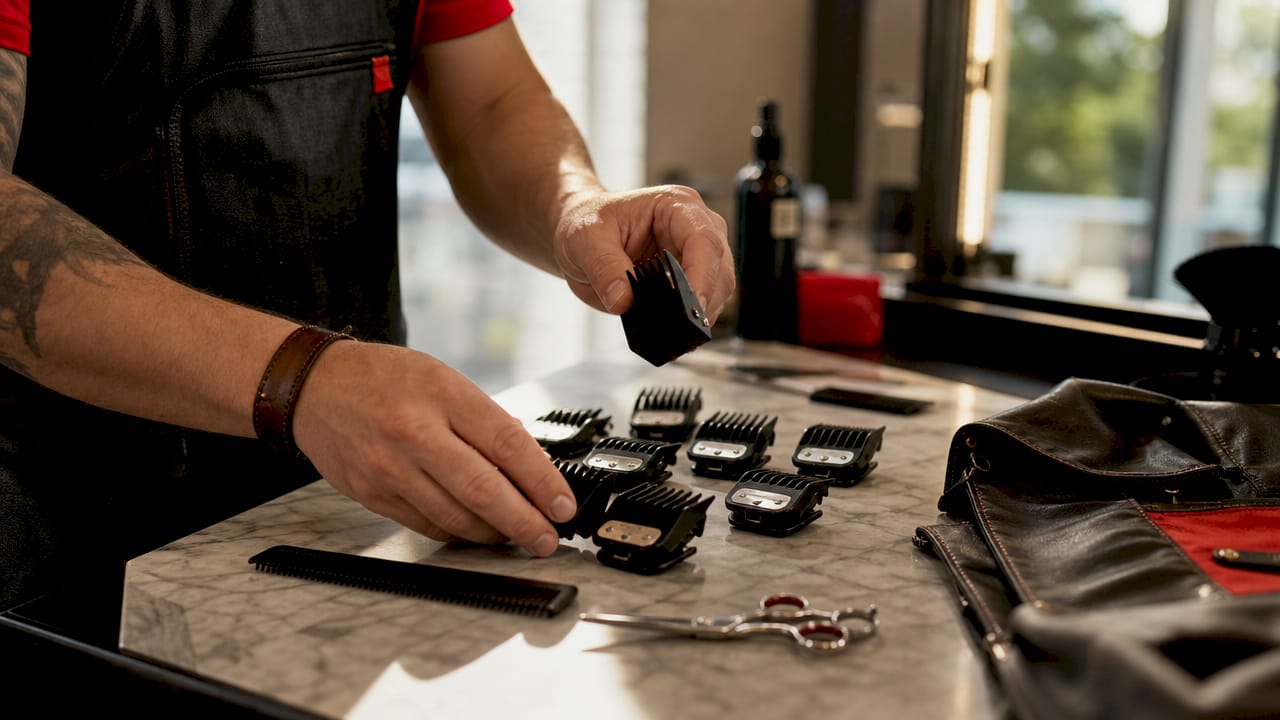
Here is a quick reference for the terms you will use most often:
Term | What it means |
Fade | Hair gradually shortens from top to sides, blending to skin |
Taper | Similar to a fade but keeps more length, less skin visible |
Guard number | Clipper attachment that controls hair length in 1/8-inch increments |
Neckline | The shape at the back of the neck: square, rounded, or tapered |
Texture | Refers to how much movement or choppiness is left in the hair |
Vague words like “short” or “clean” without context cause the most common miscommunications. A barber’s definition of “short” and yours may differ by an inch or more. Learning to describe fade style with precise fade terminology before your appointment removes that guesswork entirely.
Pro Tip: If you are unsure of the exact term, describe the result you want instead. “I want the sides to gradually disappear into the skin by the ear” communicates a skin fade without needing the label.
How do photos help you show your barber the style you want?
Visual references reduce haircut errors by 80%, making photos the single most effective tool for clear haircut communication. That number reflects a simple truth: a picture removes ambiguity that words alone cannot. When you show a barber a photo, both of you are looking at the same target.
The way you use photos matters as much as having them. Follow these practices to get the most out of your visual references:
Bring photos from multiple angles: front, both sides, and the back. A single front-facing photo hides the neckline and side profile entirely.
Choose photos of men with a similar hair type and texture to yours. A photo of thick, wavy hair shown to a barber working with fine, straight hair sets unrealistic expectations.
Use photos as a starting point for conversation, not a rigid template. Tell the barber what specifically you like: the fade height, the length on top, or the texture.
Note what you do not want. Saying “I like the fade here but want the top longer” gives your barber two data points instead of one.
Avoid bringing a collection of five different styles. Mixed references create conflicting instructions and slow the consultation.
A photographic consultation should always include remarks on what you like or dislike about each photo, rather than just showing it silently. Silence forces the barber to guess your intent. One sentence of context per photo transforms a passive handoff into an active conversation.
Pro Tip: Save two or three photos to a dedicated folder on your phone before the appointment. Scrolling through hundreds of screenshots mid-consultation wastes time and dilutes your message.
How to explain your haircut style step by step during the consultation
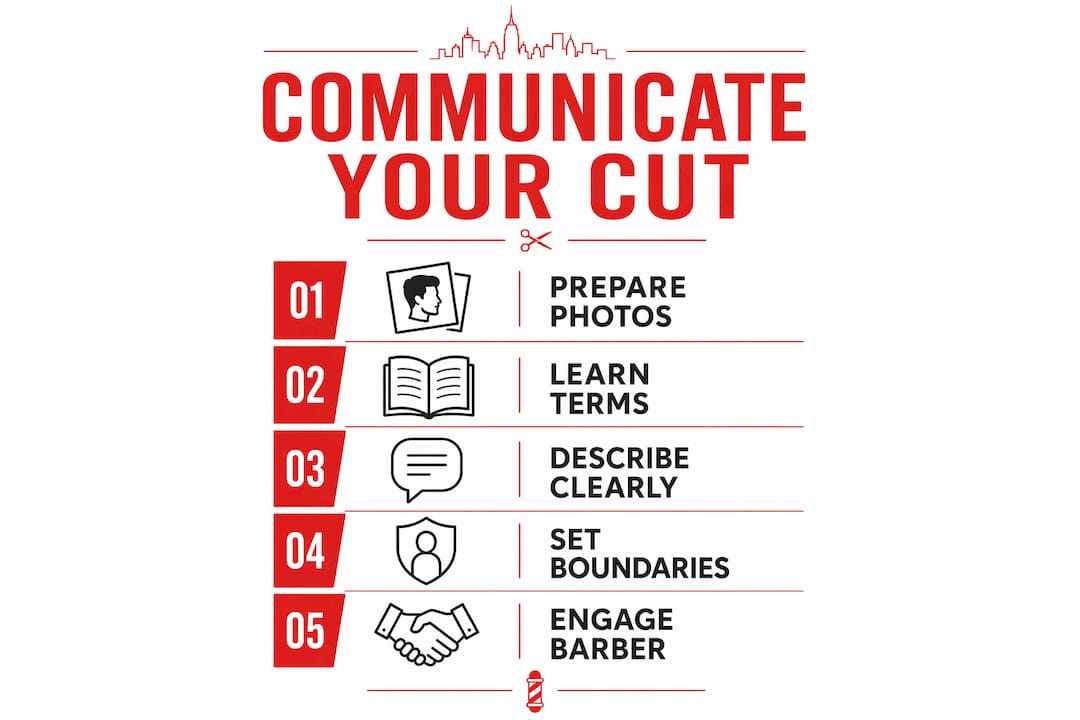
A good haircut consultation begins with a clear overall goal, then moves to specifics on sides, top, neckline, and facial hair. Think of it as a brief, organized pitch. Here is a framework that works every time:
State your overall style goal. Open with the big picture. “I want something professional and low-maintenance” or “I’m going for a sharper, more defined look” tells the barber the direction before any details are discussed.
Describe the sides and back first. This is where most of the technical work happens. Specify whether you want a fade, taper, or trim. Give a guard number if you know it. State how high you want the fade to start: low (near the ear), mid, or high (near the temples).
Detail the top. Tell the barber how much length to keep or remove. Mention whether you want texture, layers, or a clean, flat finish. Share your styling habits too. If you air-dry and never use product, say so. That information changes the cut.
Address the neckline. Choose between a squared neckline, a rounded one, or a natural taper. Each creates a different finish and affects how long the cut looks between visits.
Mention trouble spots early. Identifying hair trouble spots at the start helps barbers adapt their technique proactively. Cowlicks, receding hairlines, and unusual growth patterns all affect how a style sits. Bring them up before scissors touch your hair, not after.
Ask for the barber’s input. Once you have laid out your preferences, invite feedback. Barbers at Manhattanbarbershopny specialize in customizing cuts individually based on face shape and hair type. Their recommendation may improve on your original idea.
Speak up during the cut. If something looks off at the halfway point, say so immediately. A small adjustment mid-cut takes seconds. Waiting until the end removes that option.
When explaining a kid’s haircut style to a barber, the same framework applies with one addition: describe the child’s tolerance for the process. A child who dislikes clippers near the ears needs a barber who can work around that. Communicating haircut boundaries to a barber for a child protects both the result and the experience.
Pro Tip: Start the consultation by saying “I want to make sure we’re on the same page before you start.” That single sentence signals that you are an engaged client and sets a collaborative tone.
Common mistakes that lead to a bad haircut
The most damaging mistake clients make is using vague language and assuming the barber will fill in the gaps. Words like “short,” “clean,” and “just a trim” mean different things to different people. Without a number, a photo, or a reference point, those words are nearly useless.
Here are the mistakes worth avoiding before and during your appointment:
Assuming the barber remembers your last cut. Even a barber you visit regularly cannot recall every detail of a cut from six weeks ago. Bring a photo of the previous result or describe it from scratch each time.
Waiting until the end to raise concerns. Clients who speak up during the haircut are preferred by barbers and help avoid mistakes. Once the cut is finished, corrections are limited.
Relying on photos without explanation. A photo without context is still ambiguous. Always pair it with at least one sentence about what you want to replicate.
Ignoring the barber’s professional advice. If your barber says a certain length will not work with your hair type, that is expertise worth hearing. Understanding why hair type matters changes what is possible with a given style.
Going too short on the first visit. Starting haircuts slightly longer gives flexibility to cut more, preventing regrets from going too short. You can always take more off. You cannot put it back.
“Asking your barber about the guard size being used mid-cut is one of the best ways to stay engaged, reduce anxiety, and catch a potential error before it becomes permanent.” — Savile Row Salon
The anxiety many clients feel in the chair comes from passivity. Asking one question during the cut, even something as simple as “what guard are you using on the sides right now?” puts you back in the conversation.
Key takeaways
Clear communication with your barber requires specific language, visual references, and active participation throughout the entire appointment.
Point | Details |
Learn core terminology | Know terms like fade, taper, guard number, and neckline before you sit down. |
Use photos with context | Bring multiple angles and explain what you like about each image specifically. |
Follow the consultation framework | Start with your overall goal, then cover sides, top, neckline, and trouble spots in order. |
Speak up mid-cut | Raise concerns during the cut, not after. Small adjustments mid-session prevent major regrets. |
Build the relationship over time | Consistent communication across repeat visits makes each appointment faster and more accurate. |
Why I think most clients are one conversation away from a great haircut
Most people who leave a barbershop unhappy were not failed by their barber’s skill. They were failed by the conversation that never happened. I have seen this pattern repeat itself constantly: a client sits down, says “the usual” or “just clean it up,” and then winces at the mirror when it is done. The barber did exactly what they were told. The problem was the instruction.
Barbers genuinely prefer engaged clients. When you describe what you want, ask questions, and react honestly during the cut, you are not being difficult. You are giving the barber the information they need to do their best work. Clear, honest communication and active engagement during the cut leads to lower anxiety and better final results. That is not a soft claim. It is what barbers report consistently.
The other thing worth saying: this skill improves with every visit. The best haircuts come from repeat visits with consistent communication. Your barber learns your growth patterns, your preferences, and your lifestyle. By the third or fourth visit, you spend less time explaining and more time walking out looking exactly how you wanted. That relationship is worth building deliberately.
— Evgenii
Get the haircut you actually want at Manhattanbarbershopny
At Manhattanbarbershopny, every appointment starts with a real consultation. Eugene Solod and his team take the time to understand your style goals, hair type, and maintenance preferences before a single clipper touches your head. That is not a formality. It is the foundation of every cut they deliver.
Whether you are booking a regular haircut, a clean fade, or a kids’ haircut for your child, the team at Manhattanbarbershopny will walk you through the process so you leave confident and satisfied. Walk-ins are welcome, but booking online guarantees your spot and gives you time to prepare your photos and preferences in advance. Come in knowing what you want, and leave with exactly that.
FAQ
What is the best way to explain a haircut to a barber?
The best way to explain a haircut is to combine a photo with specific verbal details: state your overall style goal, describe the sides and back using guard numbers, and mention the length and texture you want on top. Pairing a visual reference with one or two sentences of context removes nearly all ambiguity.
How do I communicate haircut boundaries to a barber?
State your limits clearly at the start of the consultation. Tell the barber the shortest you are willing to go on each section, mention any areas you want left alone, and flag trouble spots like cowlicks or a sensitive neckline before the cut begins.
How do I explain a kid’s haircut style to a barber?
Use the same step-by-step framework as an adult cut, and add one detail: describe the child’s comfort level with clippers and scissors near the ears or neck. Shorter styles like hard parts need trims every two to four weeks, so also ask the barber which length will be easiest to maintain between visits.
Should I bring photos to my barber appointment?
Yes. Visual references reduce interpretation errors by 80%, making photos the most effective single tool for haircut communication. Bring images from multiple angles and tell the barber specifically what you like about each one.
What should I do if the haircut looks wrong mid-cut?
Speak up immediately. Barbers prefer clients who signal concerns during the cut rather than waiting until the end. Ask about the guard size being used or point to the area that looks off. A mid-cut correction takes seconds and prevents a result you will have to live with for weeks.
Recommended
Comments