Barbershop Craftsmanship History: What It Really Means

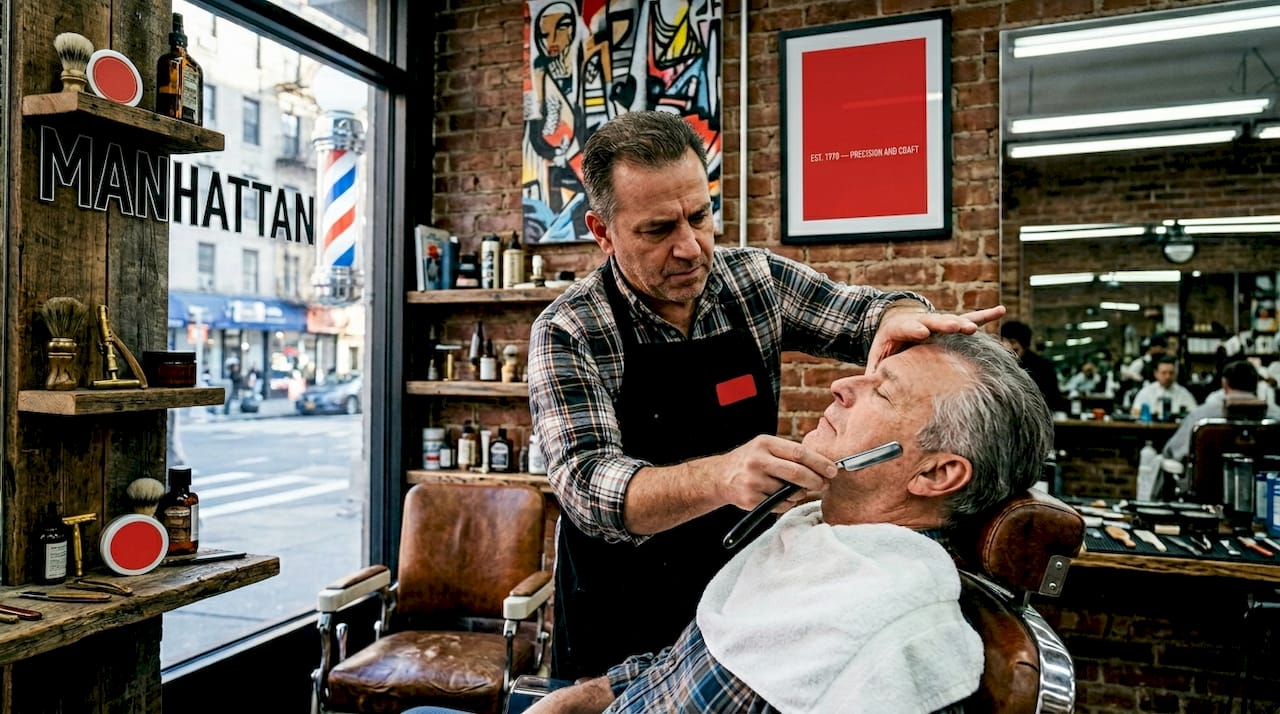
Barbershop craftsmanship history is defined as the centuries-long evolution of barbering from a combined medical and grooming trade into a refined social institution built on technical mastery, symbolic heritage, and community ritual. What does barbershop craftsmanship history mean in practice? It means understanding that every clean fade, straight-razor shave, and spinning barber pole carries the weight of a tradition stretching back to medieval Europe. The craft has always been about more than hair. It reflects how societies organized skilled labor, transmitted knowledge across generations, and created spaces where men could gather without pretense.
What is the historical origin of barbershop craftsmanship?
Barbershop craftsmanship history begins with the barber-surgeon, a figure who dominated medieval European towns by combining surgical procedures, bloodletting, and hair grooming under one roof. These practitioners were not fringe characters. They were recognized by formal guilds, held legal authority to perform minor surgeries, and operated as the primary healthcare providers for ordinary people who could not access physicians trained in academic medicine.
The connection between barbering and surgery was practical, not accidental. Monasteries in early medieval Europe required monks to maintain clean-shaven heads, and the barbers who served them already held sharp instruments and steady hands. When Church law later restricted clergy from performing surgery, barbers stepped into that role. They became the default surgeons for communities across England, France, and Germany.
The barber pole’s origin traces directly to this dual role. Red represents blood, white represents the bandages used during bloodletting, and the brass caps at each end of the pole symbolize the bowls used to collect blood and hold leeches. In the United States, blue was added, referencing either veins or national colors. That spinning pole outside a modern barbershop is not decoration. It is a compressed history lesson.
Barber-surgeons performed tooth extractions, wound cauterization, and amputations alongside standard grooming
The Company of Barber-Surgeons in England, chartered in 1540, formally united both trades under one professional body
The separation of barbering and medicine occurred through the 18th and 19th centuries as academic surgery professionalized
By the 19th century, barbers focused exclusively on haircuts, shaves, and grooming, shaping the modern barbershop identity we recognize today
Pro Tip: When you visit a traditional barbershop, look at the pole closely. If it has brass caps at both ends, you are looking at a historically accurate design that preserves the full symbolism of the barber-surgeon era.
How have apprenticeship and training shaped barbershop craftsmanship over time?
The transmission of barbering skill has always depended on direct, supervised practice rather than textbooks alone. Apprenticeship systems in barbering mirror the historic European trade guild model, where a master craftsman passed knowledge to a junior through years of hands-on work. This structure is not a relic. It remains the backbone of how skilled barbers are made today.
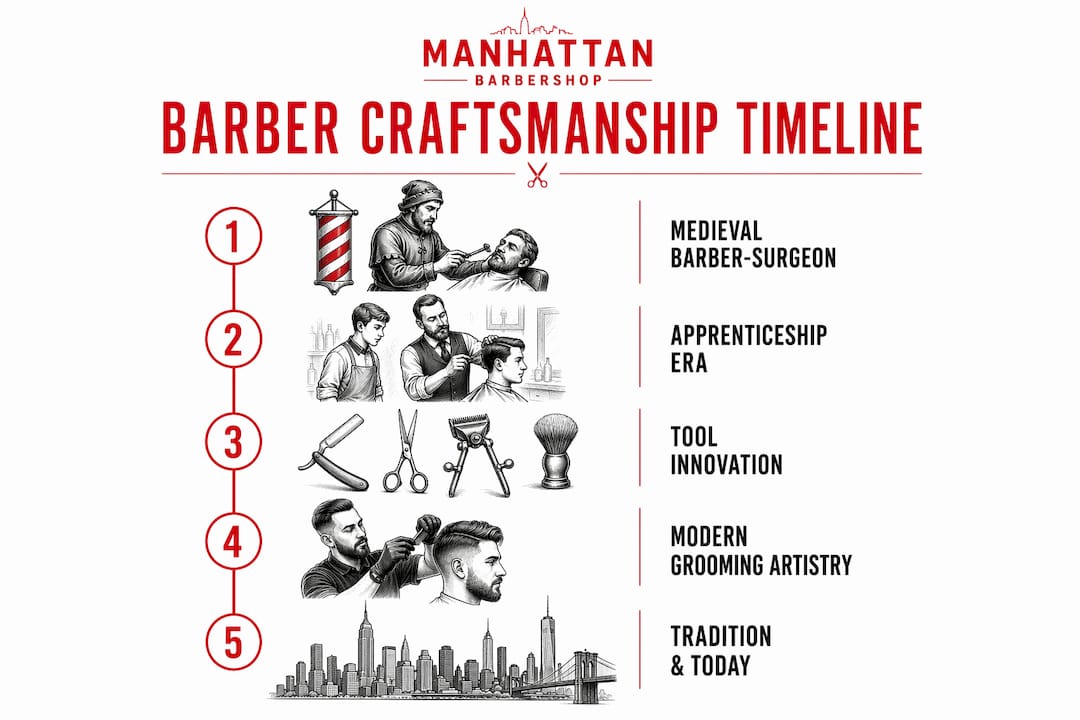
Modern barber apprenticeships typically follow a structured path that combines shop-floor experience with formal classroom instruction. Barber apprenticeships typically last about three years, incorporating weekly training days, block training weeks, and assessments covering both traditional and contemporary techniques. That duration is deliberate. Scissor control, clipper graduation, and straight-razor technique each require thousands of repetitions before they become reliable.
The stages of a typical barber apprenticeship look like this:
Foundation phase: The apprentice learns tool handling, hygiene protocols, and basic cutting geometry on training heads before touching a paying client
Supervised practice: The apprentice works on real clients under direct supervision, receiving correction in real time from an experienced barber
Technical expansion: Advanced skills including skin fades, beard sculpting, and hot towel shaves are introduced and drilled
Independent assessment: The apprentice demonstrates competency across a full service menu before earning certification
This model preserves traditional skills while absorbing new techniques. A barber trained through apprenticeship does not just know how to cut hair. They understand why each technique works, which is the difference between a technician and a craftsman. The craftsmanship tradition survives precisely because skilled barbers invest years in teaching the next generation, not just hiring them.
What symbols and tools represent barbershop craftsmanship history?
The physical environment of a traditional barbershop is a working archive of the craft’s history. Historical barber tools and furniture act as living records, allowing patrons to physically connect with past craftsmanship traditions in a way that no museum exhibit fully replicates. Some shops actively curate period furnishings and artifacts to preserve this heritage as a deliberate statement of identity, not nostalgia.
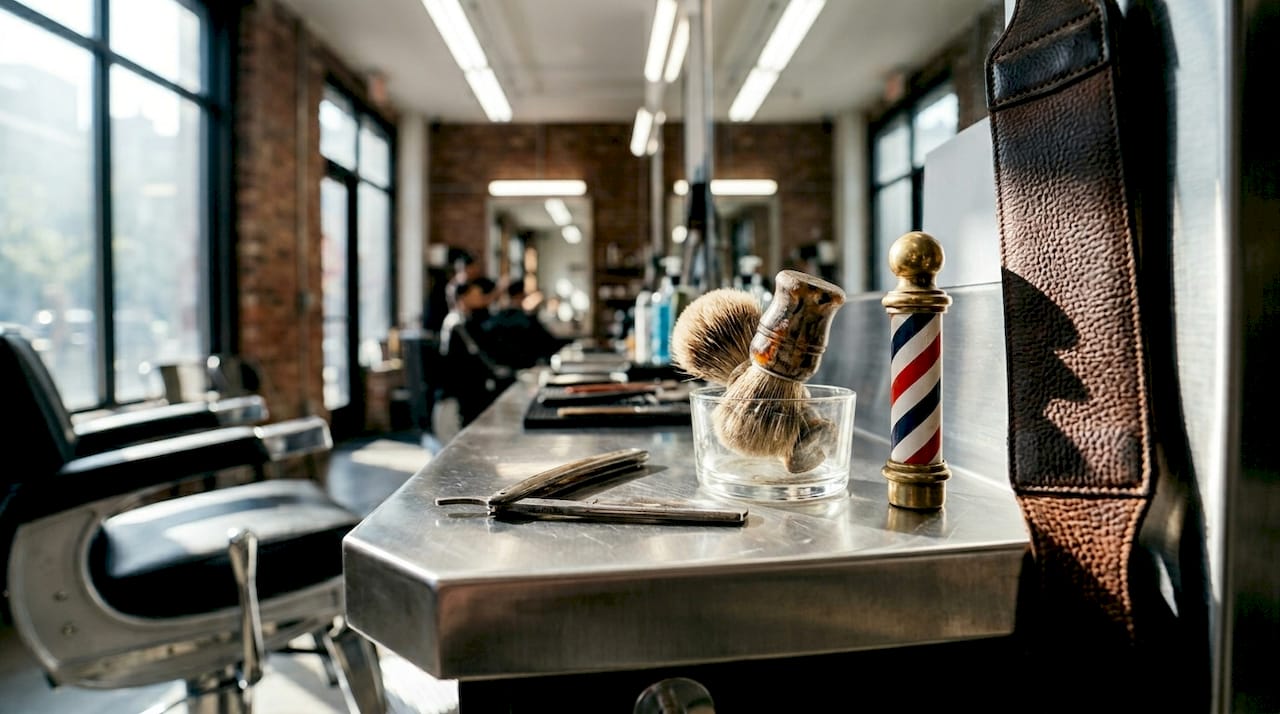
Symbol or tool | Historical meaning |
Barber pole (red, white, blue) | Represents bloodletting, bandages, and the barber-surgeon’s dual medical and grooming role |
Brass end caps on the pole | Symbolize the bowls used to collect blood during surgical procedures |
Koken or Theo A. Kochs barber chair | Cast-iron hydraulic chairs from the early 1900s signal a shop’s commitment to heritage craftsmanship |
Straight razor | Represents the precision and trust at the core of the barber-client relationship |
Hot lather machine | Connects modern shave rituals to the pre-electric era of traditional wet shaving |
The barber chair deserves particular attention. Early hydraulic chairs manufactured by companies like Koken Barbers’ Supply Company in St. Louis were engineering achievements that also communicated status. A client sitting in one of those chairs was not just getting a haircut. They were participating in a ritual that signaled the shop’s seriousness about its craft.
Pro Tip: If you want to understand barbershop artistry at its deepest level, visit the Barber Museum in Canal Winchester, Ohio. It holds one of the largest collections of antique barber chairs, poles, and tools in the United States, and it reframes the entire history of the trade in a single afternoon.
Why does barbershop craftsmanship history matter today?
The barbershop history significance extends well beyond technical skill. Barbershops have historically functioned as social hubs that foster male intimacy and communal exchange, with craftsmanship providing the atmosphere that makes that exchange possible. Psychological research describes barbershops as containers for acceptable male vulnerability, spaces where men discuss health, family, and identity in ways they rarely do elsewhere.
Understanding barbershop craftsmanship means recognizing that the quality of the cut and the quality of the conversation are not separate things. They reinforce each other. A barber who has mastered their craft earns a client’s trust, and that trust opens the door to the kind of relationship that keeps someone returning for years.
Shops like Minnesota’s 7th Street Barbers, operating continuously since the 1890s, demonstrate how craftsmanship history anchors community identity across generations
The ritual elements of a traditional barbershop visit, including the hot towel, the straight-razor finish, and the talc brush, are deliberate continuations of historical practice
Economic pressures including rising rents and younger barbers avoiding long apprenticeships put the continuity of these traditions at genuine risk
Shops that invest in preserving craftsmanship traditions consistently build stronger client loyalty than those that treat haircuts as a commodity transaction
The barbershop traditions explained through this lens are not about nostalgia. They are about the practical value of a space where skill, trust, and community converge. That combination is rare, and it does not happen by accident.
How do barbershops balance tradition and modern grooming artistry?
The transition from barber-surgeon to specialized grooming professional was not a loss of identity. It was a refinement. Once medicine and barbering formally separated in the 19th century, barbers could concentrate entirely on the art of grooming, developing techniques and tools with a focus that the dual-role practitioner never had. That specialization produced the modern barbershop identity we recognize today, one built on precision, personal service, and a distinct aesthetic vocabulary.
Contemporary barbers integrate historical techniques with modern demands. The skin fade, which requires blending hair from bare skin to a chosen length with no visible line, is a modern evolution of the graduation techniques barbers have practiced for over a century. The tools have changed, with ceramic blade clippers and adjustable guards replacing hand-operated clippers, but the underlying skill of reading hair growth patterns and adjusting pressure accordingly is unchanged.
Craftsmanship in barbering today means holding both dimensions simultaneously. A barber who understands the history of barbershop techniques brings a different quality of attention to each client than one who learned only from YouTube tutorials. Historical knowledge informs judgment. It tells a barber why a particular technique was developed, which reveals when and how to apply it. That depth is what separates a great barber from a competent one, and it is exactly what distinguishes great barber skills in any era.
Key takeaways
Barbershop craftsmanship history is the record of how barbering evolved from a dual medical and grooming trade into a community institution defined by technical mastery, symbolic heritage, and apprenticeship-based skill transmission.
Point | Details |
Barber-surgeon origins | Medieval barbers performed surgery and grooming, giving the craft its dual identity and iconic symbols. |
The barber pole as history | Red, white, and blue colors encode the full story of bloodletting, bandages, and the barber-surgeon’s role. |
Apprenticeship as preservation | Three-year apprenticeships transmit both traditional and modern techniques, keeping the craft alive across generations. |
Barbershops as social institutions | Shops function as community anchors where craftsmanship creates the trust that enables genuine human connection. |
Tradition and modernity coexist | Historical knowledge of techniques directly improves the quality and judgment of contemporary barbering practice. |
Why this history still cuts deep
I have spent years watching clients walk into a barbershop with their shoulders up and walk out with them down. That shift is not just about a good haircut. It is about being in a space where someone genuinely skilled is paying attention to you. That experience has a history, and understanding barbershop craftsmanship history makes it richer.
What strikes me most is how few people realize the barber pole outside their local shop is a direct artifact of medieval surgery. That continuity is extraordinary. The craft has survived plague, industrialization, the rise of chain salons, and the pandemic. It survives because the apprenticeship model keeps producing barbers who care about what they do, and because clients keep returning to shops that honor the tradition.
The uncomfortable truth about modern grooming culture is that convenience has flattened a lot of it. Fifteen-minute chain haircuts exist, and they serve a purpose. But they cannot replicate what a skilled barber with a real understanding of their craft’s history delivers. The ritual matters. The relationship matters. The knowledge that the person holding the razor has trained for years and respects a tradition that predates modern medicine, that matters too.
If you have never sat in a shop that takes all of this seriously, you are missing something that is genuinely difficult to describe and very easy to feel.
— Evgenii
Experience traditional craftsmanship at Manhattanbarbershopny
Manhattanbarbershopny, led by owner Eugene Solod, is built on exactly the kind of craftsmanship this article describes. Every cut at this Upper East Side shop reflects years of trained skill, attention to individual hair type, and a commitment to styles that look natural and hold their shape for weeks without heavy product use.

Whether you are looking for a clean fade, a classic taper, or a straight-razor finish rooted in traditional technique, Manhattanbarbershopny delivers it with the kind of focused attention that chain establishments cannot match. Walk-ins are welcome, and booking online takes under a minute. If you want to experience what barbershop craftsmanship actually feels like in practice, this is the place to start. You can also explore expert haircuts and pricing to find the right service for your style.
FAQ
What does barbershop craftsmanship history mean?
Barbershop craftsmanship history refers to the evolution of barbering from the medieval barber-surgeon era through modern specialized grooming, encompassing technical skills, symbolic heritage, and the social role of barbershops as community institutions.
What is the significance of the barber pole?
The barber pole’s red, white, and blue colors represent blood, bandages, and the barber-surgeon’s dual medical and grooming role, with brass end caps symbolizing the bowls used during bloodletting procedures.
How long does a barber apprenticeship take?
Barber apprenticeships typically last about three years, combining supervised shop experience with formal classroom instruction covering both traditional and contemporary techniques.
Why are barbershops considered social institutions?
Psychological research identifies barbershops as spaces that foster male intimacy and communal exchange, where the barber’s craftsmanship creates the trust that enables open conversation beyond the haircut itself.
How does historical knowledge improve modern barbering?
A barber who understands the history of barbershop techniques knows why each method was developed, which sharpens their judgment about when and how to apply it, producing consistently better results than technique alone.
Recommended
Comments