Most Men Need a Haircut Every 3 to 4 Weeks: Barber Backed Cadence


Most men need a haircut every 3 to 4 weeks, but the real answer depends on your style. Short, precision cuts like skin fades demand a trip every 1 to 3 weeks, while longer styles can stretch to 6 or even 12 weeks between full cuts. The signal that actually matters more than any calendar: when your styling time doubles or the cut loses its original shape, you’re overdue. Everything below breaks that range down by length, texture, and lifestyle so you can build your own schedule.
TL;DR:
Fades and skin cuts require visits every 1 to 2 weeks to maintain sharp contrast, while standard fades and short tapers can stretch to 2-3 weeks.
Medium styles like pompadours typically need attention every 4 to 6 weeks, with styling and shape being key indicators for booking sooner.
Long hair usually needs a shaping trim every 6 to 12 weeks, with more frequent trims if maintaining split ends or damaged layers.
Hair growth rate, texture, and lifestyle demands significantly influence how often you should schedule haircuts.
Booking appointments in advance and using simple at-home touch-ups help maintain consistent style and optimize visit frequency.
Table of Contents
How Often Should Men With Short Hair Get a Haircut?
Short styles fall apart the fastest, and that’s not a flaw. It’s the tradeoff for the sharp lines that make them look good in the first place. A skin fade lives or dies by contrast between skin and hair, and that contrast softens within days. Barber guides consistently put skin fades on a 1 to 2 week rotation, while regular fades and short tapers can usually stretch to 2 to 3 weeks before the blend starts looking muddy.
Buzzcuts and crew cuts are a little more forgiving. Because there’s minimal length to lose shape in the first place, most guys get away with 3 to 4 weeks between visits, sometimes longer if the cut was done with attention to the neckline and hairline.
Skin/bald fades: every 1 to 2 weeks
Standard fades and short tapers: every 2 to 3 weeks
Buzzcuts and crew/Ivy League cuts: every 3 to 4 weeks
You can stretch a short cut by a week or so with neckline upkeep alone. A quick trim of the neck and sideburns at home, or a $5 to $10 “neck and blend” touch up at the shop, buys extra days without a full reshaping session. If you’re not sure which fade style holds shape longest for your hair, our guide on choosing between a low and mid fade breaks down which one actually saves you barber visits over the year.
Pro Tip: Leaving slightly more length on top during a fade can give a few extra days of wear before the top starts looking disconnected from the faded sides.
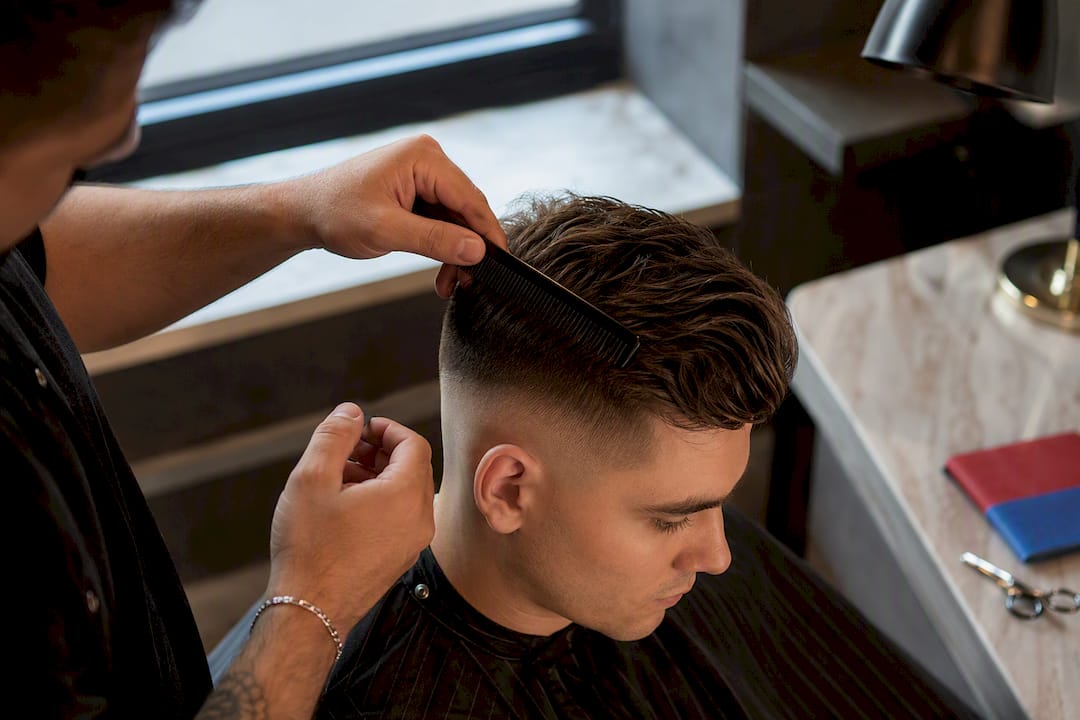
What’s the Right Cadence for Medium-Length Styles?
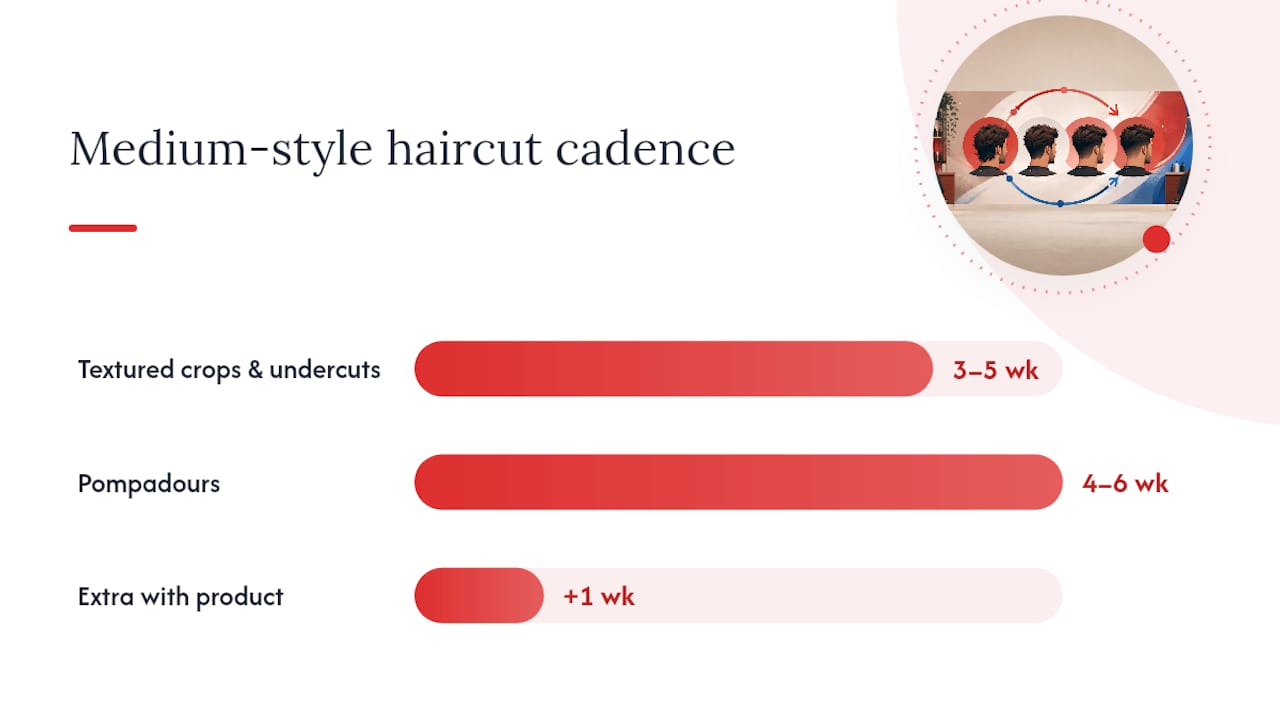
Textured crops, undercuts, and pompadours occupy the middle ground, and that middle ground is more flexible than most men assume. Most medium styles hold their shape for 3 to 5 weeks, with some structured looks like pompadours needing attention closer to the 4 to 6 week mark depending on how much height and definition you want to maintain.
The tricky part with medium length is that product and a good blow-dry can mask a lot of overgrowth. You can often push a week past when you’d normally book if you’re willing to work a little harder with styling cream in the morning. But there’s a limit: once the sides start creeping over your ears or the top loses its ability to hold a defined part, no amount of product fixes it.
Textured crops and undercuts: every few weeks to over a month
Pompadours and styles needing height: about one to one and a half months
Signal to book sooner: styling takes noticeably longer or the silhouette looks blurred rather than sharp
Ask specifically for a “shaping trim” rather than a full cut if you’re trying to hold onto length while keeping the outline clean. It’s a smaller service that refreshes the perimeter without taking your medium style back to short.
How Often Should Men With Long Hair Get a Trim?
Long hair plays by different rules entirely. Full reshaping typically happens every 6 to 12 weeks, and barber and grooming guides agree that longer styles simply need less frequent attention than short ones because there’s no sharp line or fade to maintain.
That said, a full cut isn’t the same as a maintenance trim. If you’re actively trying to keep split ends from creeping up the shaft and ruining the ends, a trim every 6 to 8 weeks does more for the overall look than waiting for the full 12 week mark.
Full shaping cuts: roughly every one and a half to three months
Maintenance trims to control split ends: about every one and a half to two months
Chemically treated or damaged hair: trims needed more frequently, often every one and a half to two months regardless of length
Chemically treated or heat damaged hair breaks more easily and needs trims on the shorter end of that window to stay healthy while you grow it out. If you’re growing toward a specific long style, our roundup of natural hairstyles and the barber chair phrases that get you there covers how to communicate that goal clearly at each visit.
What Factors Change How Often You Need a Haircut?
The ranges above are starting points, not fixed rules. A handful of variables push you toward the shorter or longer end of each window.
Growth rate. Hair grows at roughly half an inch per month for most people, which is a useful baseline for estimating how fast a style will grow out of shape.
Texture and thickness. Fine, straight hair shows overgrowth almost immediately, while curly or coarse hair can hide length change for longer but loses its definition sooner, since curl pattern depends on precise layering.
Work and lifestyle demands. A client-facing job, frequent events, or regular sports and sweat all shorten the practical window between cuts.
Season and events. Humidity changes how fades and textured cuts hold up, and big occasions deserve planning. Book 3 to 4 days before a wedding or interview so the cut has time to settle rather than looking freshly buzzed in photos.
Growing Out Your Hair Without Losing the Shape
Trims during a grow out phase serve one purpose: they remove split ends and keep the silhouette intact. They don’t speed up how fast hair grows from the scalp, so skipping cuts entirely doesn’t get you to your goal length any faster. It usually gets you there with damaged, uneven ends.
A workable growth plan looks like a trim every 6 to 8 weeks, with the barber removing minimal length and focusing purely on shape.
Tell your barber you’re growing your hair out, not just getting “a haircut”
Ask for shaping only, with minimal weight removal
Request layers that support your target length rather than a fresh, shorter silhouette
This kind of targeted brief is the difference between a trim that protects your progress and one that accidentally resets your timeline by a month.
How Do You Build a Haircut Schedule That Sticks?
The simplest fix for haircut inconsistency is booking your next appointment before you leave the chair. A standing recurring booking, whether that’s every 2 weeks or every 6, removes the guesswork and tends to be cheaper than waiting until things look bad and needing a full corrective reshaping.
Think in annual terms to budget realistically. A 2 week cadence puts you at roughly 26 visits a year. A 4 week cadence lands closer to 13. A 6 to 8 week cadence for longer styles might mean 6 to 9 visits annually. Map that against your usual per cut cost to see what your grooming routine actually runs you each year.
Set a recurring calendar reminder or standing appointment with your barber
Use quick neckline or beard touch ups between full cuts to stretch the interval
Treat a gap longer than a couple of months as a sign you’ll need a longer reshaping session, not just a quick trim
Pro Tip: If cost is the concern, ask your barber about multi-session packages. Prepaying for several visits can work out cheaper per cut than booking one at a time.
What Should You Tell Your Barber Between Visits?
Getting a consistent result starts with a clear brief, not a guess. Tell your barber the specific interval you’re aiming for, like “I come in every 3 weeks, keep the fade tight,” so they cut with your next 3 weeks in mind rather than just today.
State your cadence and priority. Say whether you value sharpness now or longevity over the coming weeks.
Keep a simple at-home kit. A matte paste or clay, a boar bristle brush, and a trimmer for neckline touch ups cover most upkeep needs.
Know your limits. Neckline and sideburn cleanup are fine to do yourself. Reshaping a fade or fixing an uneven line at home usually makes things worse, not better.
Watch for red flags. Styling taking twice as long, a fade losing contrast, or visible unevenness all mean it’s time to book, regardless of what the calendar says.
For a ready-made way to describe exactly what you want, our guide to describing fade styles to your barber gives you the language that gets consistent results every visit.
How Manhattan Barbershop Approaches Haircut Cadence
Appointments can be built around each client’s actual schedule, not a generic interval. For example, a client getting a clean skin fade may book every 1 to 2 weeks, while someone growing out a textured crop may get shaping trims every 4 to 5 weeks. Clients working toward longer natural styles may get minimal, growth-focused trims every 6 to 8 weeks. An approach that favors clean fades and classic cuts helps styles hold their shape between visits, allowing clients to stretch intervals without losing the look.
A Barber’s Take on Sticking to a Schedule
The clients who look the most put together aren’t the ones who show up in a panic before an event. They’re the regulars who book their next appointment on the way out the door. Treat your haircut like scheduled maintenance, not a fix you reach for when things already look off.
— Evgenii
Book Your Next Cut on a Cadence That Works
Once you know your ideal interval, the hard part is actually sticking to it. Manhattan Barbershop makes that easy with online booking that lets you lock in your next appointment before you even leave the chair, so a 2 week fade cycle or a 6 week trim schedule happens automatically instead of depending on you remembering.

Whether you’re maintaining a tight skin fade, reshaping a growing out crop, or protecting length while you grow your hair longer, a personalized consultation at each visit keeps your cadence on track. Head to the booking page to schedule your next appointment, or browse the Manhattan Cuts Magazine for more style specific upkeep guides before you go in.
Sources
FAQ
What Is the 3:2:1 Rule for Haircuts?
There’s no single standardized “3:2:1 rule” in professional barbering; it’s a shorthand some guides use loosely to describe layered cutting ratios or blending zones on a fade. If your barber uses a version of it, ask them to explain the specific ratio they’re applying to your cut.
Is a $5 Tip on a $25 Haircut Good?
Many clients tip higher for detailed work like a skin fade or a first visit with a new barber.
What Does the 7 Day Haircut Rule Mean?
This isn’t an established industry standard, but it often refers to giving a fresh cut about a week to settle before judging it, since fades and tapers look sharpest right after cutting and soften naturally within days. It’s also used informally to suggest scheduling a trim a week before a big event.
What Is the 2.25 Rule for Hair Length?
This isn’t a recognized barbering or dermatology standard. If you’ve seen it referenced, treat it as informal advice rather than an established guideline, and talk to your barber directly about how much length to remove for your goals.
How Often Should Men Get a Haircut if They Wear a Fade?
Most fades need a refresh every 2 to 3 weeks, while skin and bald fades often need attention every 1 to 2 weeks to keep the sharp contrast. It is recommended to book your next appointment before leaving so the fade never fully grows out between visits.
Recommended
Comments